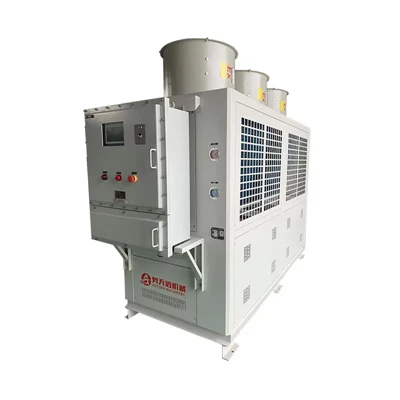
Hey there! As a supplier of High Precision Chillers, I often get asked about how to calculate the cooling capacity needed for these high - tech machines. It's a crucial question because getting the cooling capacity right can make or break the performance of your chiller. So, let's dive right in and figure this out together.
Understanding the Basics of Cooling Capacity
First off, what exactly is cooling capacity? Well, it's the amount of heat that a chiller can remove from a space or a process within a specific period. We usually measure it in British Thermal Units (BTUs) per hour or in kilowatts (kW).
Let's say you're using a chiller to cool down a high - precision manufacturing process. If the chiller doesn't have enough cooling capacity, the temperature won't stay at the right level. That can lead to all sorts of problems, like inaccurate product dimensions or even damage to sensitive equipment. On the other hand, if you over - size the chiller, you're wasting energy and money. So, it's super important to get it just right.
Factors Affecting Cooling Capacity Requirements
There are several factors that you need to consider when calculating the cooling capacity for a high - precision chiller.
Heat Load from the Process
The heat generated by the process itself is a major factor. For example, in a laser cutting machine, the laser generates a significant amount of heat. You need to know how much heat is produced per hour. This might involve looking at the machine's technical specifications or doing some tests.
Let's say a laser cutting machine has a power rating of 5 kW. A good rule of thumb is that about 80% of the electrical power is converted into heat. So, the heat load from this machine would be 5 kW x 0.8 = 4 kW.
Ambient Temperature
The temperature of the surrounding environment also plays a big role. If you're operating the chiller in a hot factory, the chiller has to work harder to cool the process. For instance, if the ambient temperature is 35°C instead of 25°C, the chiller will need more cooling capacity to maintain the same process temperature.
Insulation
How well the process equipment is insulated can affect the cooling capacity. Good insulation reduces the amount of heat transfer between the equipment and the environment. If your equipment is well - insulated, the chiller won't have to work as hard to remove the heat.
Number of Equipment
If you have multiple pieces of equipment that need to be cooled, you need to add up the heat loads from all of them. For example, if you have three laser cutting machines with the same heat load of 4 kW each, the total heat load from the machines would be 4 kW x 3 = 12 kW.
Calculating the Cooling Capacity
Now that we know the factors, let's look at how to calculate the cooling capacity.
Step 1: Determine the Heat Load from the Process
As we mentioned earlier, you need to find out how much heat is generated by the process equipment. You can do this by looking at the equipment's power ratings and efficiency. If the equipment has a power rating of P (in kW) and an efficiency of η, the heat load Q (in kW) can be calculated using the formula: Q = P x (1 - η).
Step 2: Account for Ambient Temperature
To account for the ambient temperature, you can use a correction factor. A common correction factor is around 1.1 - 1.3, depending on how hot the environment is. So, if your calculated heat load from the process is Q1, the adjusted heat load Q2 would be Q2 = Q1 x correction factor.
Step 3: Consider Insulation and Other Losses
If your equipment is well - insulated, you can reduce the heat load slightly. Let's say you estimate that the insulation reduces the heat load by 10%. Then the final heat load Q3 would be Q3 = Q2 x (1 - 0.1).
Step 4: Add Up the Heat Loads from Multiple Equipment
If you have multiple pieces of equipment, simply add up the final heat loads from each piece.
Let's do an example. Suppose you have a high - precision manufacturing process with two pieces of equipment. One has a power rating of 3 kW and an efficiency of 0.7, and the other has a power rating of 4 kW and an efficiency of 0.8. The ambient temperature is high, so we'll use a correction factor of 1.2. And let's assume the insulation reduces the heat load by 10%.
For the first equipment:
Q1_1 = 3 kW x (1 - 0.7)= 0.9 kW
Q2_1 = 0.9 kW x 1.2 = 1.08 kW
Q3_1 = 1.08 kW x (1 - 0.1)= 0.972 kW
For the second equipment:
Q1_2 = 4 kW x (1 - 0.8)= 0.8 kW
Q2_2 = 0.8 kW x 1.2 = 0.96 kW
Q3_2 = 0.96 kW x (1 - 0.1)= 0.864 kW
The total cooling capacity needed Q_total = Q3_1+Q3_2 = 0.972 kW + 0.864 kW = 1.836 kW
Our High Precision Chillers
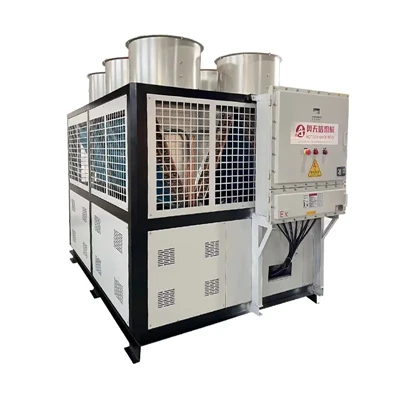
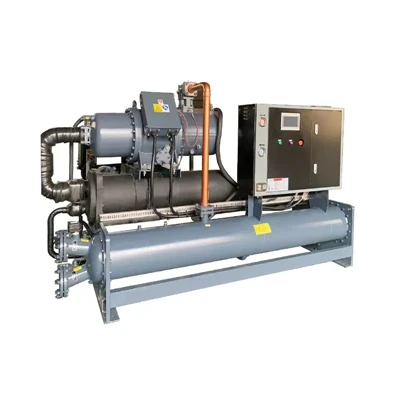
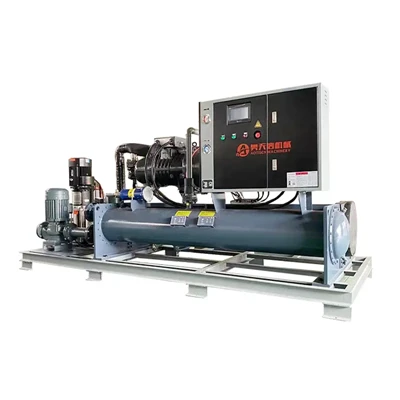
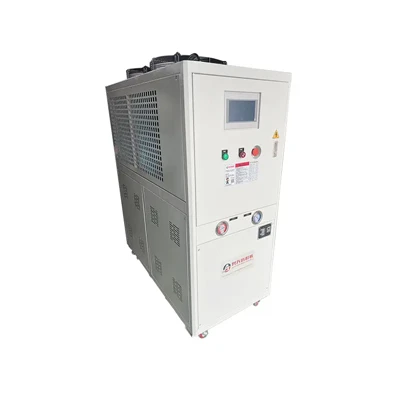
At our company, we offer a range of High Precision Chillers that are designed to meet the specific needs of high - precision processes. Our chillers are equipped with advanced technology to ensure accurate temperature control.
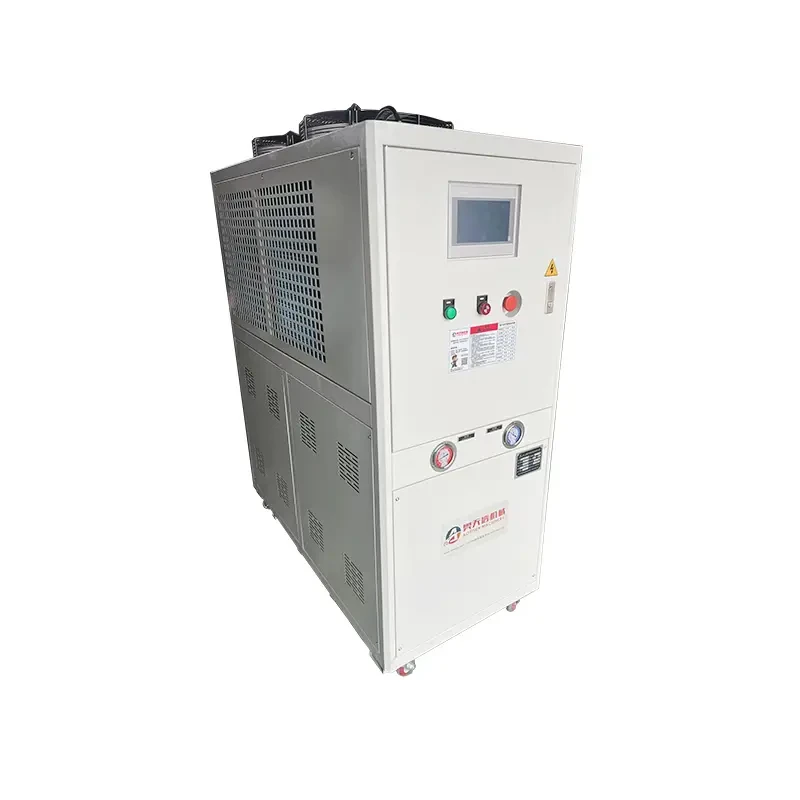

We also have other types of chillers, such as EX Proof Industrial Chiller, Explosion Resistant Cooling Chiller, Low Temp Chiller, and Explosion Proof Chiller. These chillers are suitable for different applications, especially in environments where safety is a major concern.
Conclusion and Call to Action
Calculating the cooling capacity for a high - precision chiller is not as complicated as it might seem. By considering the heat load from the process, ambient temperature, insulation, and the number of equipment, you can get a pretty accurate estimate.
If you're in the market for a high - precision chiller or any of our other chiller products, we'd love to hear from you. Whether you need help with calculating the cooling capacity or have any other questions, our team of experts is here to assist you. Contact us to start a discussion about your chiller needs and find the perfect solution for your business.
References
- ASHRAE Handbook of Fundamentals
- Chiller Manufacturer's Technical Guides